How to Loosen Up a Tight Acrylic Painting (The Paper Smear Trick)
Acrylic painting feeling too tight? Smear it with paper and a spray bottle, use a paper straight edge, and balance crisp and messy edges.


Is your acrylic painting getting too tight? Here’s the trick I use to break the tension: smear it with a piece of paper.
Prep canvases ahead of time
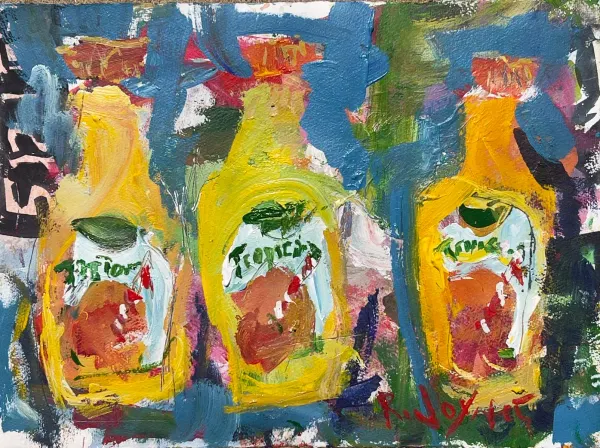
This one started with an 11x14 canvas I’d used as a mixing palette. I glued old papers and drawings onto it with decoupage glue, completely at random. I had no plan to paint on it.
That’s a good habit. Break in a few canvases whenever you’re in the garage or studio, set them aside, and come back when you’re ready to paint. You’ll have interesting layers waiting for you. For a similar idea, see collage acrylic still life.

Want to Paint Loose Acrylics, Slacker? Learn the fundamentals, loosen up your brushwork, and develop your own expressive style.
Block in with a light touch
For the block-in, I used paint right out of the jar but barely dragged the brush across the canvas, so some of the layers underneath still show. I also used acrylic ink. It’s transparent, blends well with acrylic, and layers beautifully. And it’s easy to open, unlike my big jars of acrylic that sometimes need a sledgehammer.
Pick and choose the details
The package has tons of lettering. I didn’t paint every letter, just the main ones needed for the viewer to recognize it right away. Chunk things in first, then come back later with a little negative space painting to carve out clean edges. See also paint everyday objects.
The smear: add a creative disruption
About halfway through, things felt too tight. I was describing the package and the words instead of responding to the painting.
So while the paint was still wet, I grabbed a piece of paper and a small spray bottle, smacked the paper onto the surface, and smeared everything around. It looked reckless, but that disruption was exactly what the painting needed.
Use paper as a straight edge
I couldn’t get the tops of the letters straight, so I used a sheet of paper as a straight edge to get a clean line. It gave a nice contrast to all my imperfect shapes and smudges.
A painting needs balance. It can’t all be smudgy. It needs some clean, crisp edges and some things that fall apart.
Know when to stop
At about 3/4 done, it’s easy to get fussy: this edge is muddy, I need that detail. But if the painting is working and you can see the subject, less is best. Let some loose, abstract areas survive. Step back and ask, “How much information do I really need?” More in how to know when to stop painting.
Sometimes a painting doesn’t need another careful brushstroke. It needs an interruption. For more, see 10 tips for painting loose.
Learn Structure. Paint Loose.
Construct. Deconstruct. Explore. Repeat.
Tight acrylic painting FAQ
Why is my acrylic painting too tight?
You’re probably describing the subject instead of responding to the painting. Break the tension with a bold move.
How do I smear acrylic paint?
While it’s still wet, mist it lightly and press and drag a sheet of paper across the surface.
What is acrylic ink?
A transparent, fluid ink that mixes well with acrylic and is great for layering.
How do I get a clean straight edge?
Use a sheet of paper as a guide and paint along it.