How to Start Mixed Media: Crayon, Watercolor, and Your Old Rejects
Wondering how to start mixed media painting? Here’s how I got into it 20 years ago with crayons and watercolor, and how old rejects became my starting point.


Mixed media started for me back in 2000. At the time I was doing watercolor, just watercolor, and then I came across an artist mixing crayons into his work. I thought, “Wow, I love that.”
In this post I share how I got started, and how you can too.
Why I waited to try mixed media
I knew mixed media existed, but I never pictured what it would look like for me. I was so busy trying to understand watercolor that adding anything else seemed like too much.
But I couldn’t get the vision out of my head. It spoke to me in a way watercolor wasn’t. So I ordered a bunch of crayons and started mixing. After the first session, I knew mixed media had much more to offer than staying in one lane.

Want to Create Loose Mixed Media Art, Slacker? Learn the fundamentals, experiment with collage and layers, and develop your own expressive style.
Start with your rejects
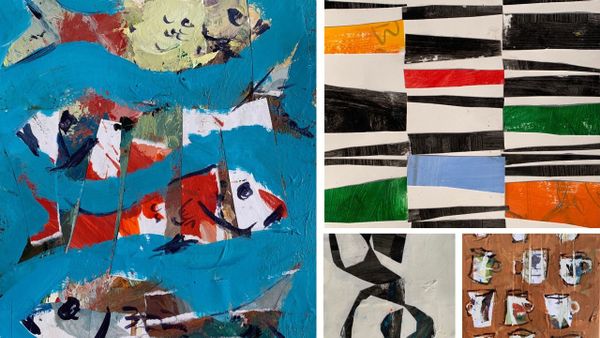
Mixed media opened up everything, including the pile of old rejects: watercolor landscapes and studies that didn’t make it. Suddenly they weren’t rejects anymore. I could add crayon, graphite, and acrylic, and one thing led to another.
An easy way in: take an old watercolor and add crayon or graphite on top. See what to do with paintings you hate, how to paint over an old acrylic painting, or use a bad painting as a palette.
Keep the fundamentals underneath
What I love is that you can bring it all back to strong fundamentals: design, composition, drawing, and getting a likeness without copying. I’m not a non-representational painter, so I need something there. But the subject is only something to get me going. I’m attached to the process, not the subject. (This painting is two rejects and a box of candy.)
The trap of finished art
Finished art can be a trap. You can make a finished piece without learning anything or gaining any creativity from it, and sometimes the opposite.
I know I can paint a decent acrylic landscape with lobster boats and walk away, but there’s no satisfaction in that. The real reward is the sessions where I’m pushing what I already know. They don’t pay off today. They pay off from tearing things down, rebuilding, and getting away from the safe stuff.
Twenty years later, there’s not one painting I’d point to as “the one.” What sticks with me are the moments: collage getting glued down, a brush scrubbing across the surface, graphite on a hard board.
Your goals will change
Early on, my goal was to paint something finished that looked legitimate in watercolor. When I achieved it, it stopped being fulfilling. I realized the goal needed to change. Now I love constructing, deconstructing, and finding new ways to put things back together. For more, see how to find your own art style and how to paint loose.
Try it yourself
- Dig out an old watercolor you gave up on.
- Add crayon, then graphite or acrylic.
- Don’t aim for finished. Stay with the process.
- Hang it up and see what you notice.
Learn Structure. Paint Loose.
Construct. Deconstruct. Explore. Repeat.
Starting mixed media FAQ
How do I start mixed media painting?
Begin with an old watercolor or drawing and add crayon, graphite, or acrylic on top.
Can you use crayon with watercolor?
Yes. Wax crayon resists watercolor, so you get broken, textured marks.
What materials do I need for mixed media?
Start with what you have: old paintings, crayons, graphite, and acrylic.
Do I need to finish my mixed media paintings?
No. The process matters more. Many sessions won’t produce finished art, and that’s fine.