How to Critique Your Own Painting (and Decide What to Fix)
Not sure why a painting feels off? Here’s how I critique my own work: spot stiff shapes, straight lines, and dull color, then fix it or start fresh.


Ever finish a painting and think, “something’s off, but I can’t say what”? Here’s how I critique my own work, using a few paintings that didn’t make the cut.
A reject is just a layer
First, these don’t bother me. They’re not failures. A reject is always just a layer. That mindset makes it much easier to look at a painting honestly. More on that in what to do with rejected paintings.
What to look for
When I look at a reject, these are the things nagging at me:
- Too predictable. The pink was in two spots, nothing organic or natural about it.
- Too stiff or boxy. A straight line that doesn’t interact with the edge of the canvas. An angle would have been nice.
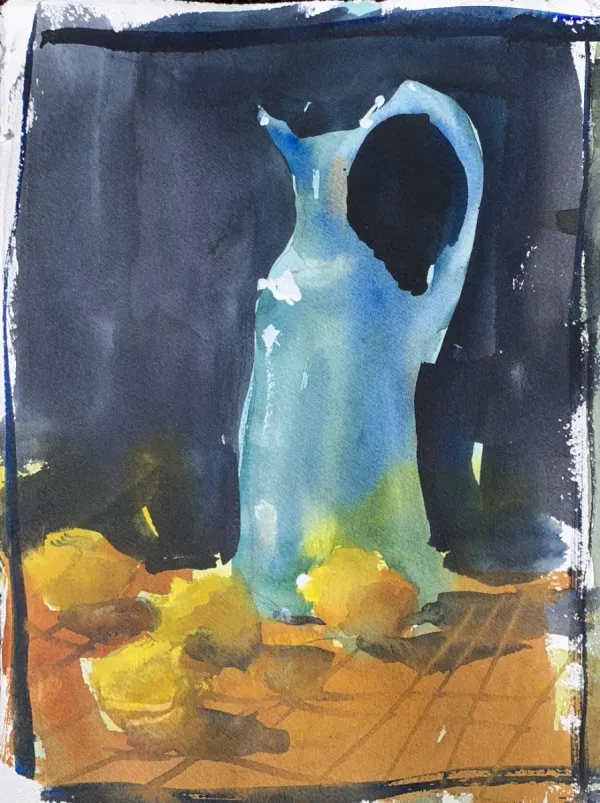
- Dull or flat color. One yellow worked, but everything else was dull, and the same blue everywhere with no variation.
- Not enough description. Messy bits are good, but the viewer needs something to latch onto, like a label or a believable shape.
If your paintings feel stiff, see also why watercolor looks stiff.

Want to Create Loose Mixed Media Art, Slacker? Learn the fundamentals, experiment with collage and layers, and develop your own expressive style.
Use angles instead of straight lines
This was the big one on the harbor painting. The horizon was straight, the bottom of the boat was straight, and the tops of the trees and houses all lined up. Everything ran parallel to the edge.
A few easy fixes:
- Tilt the boat slightly.
- Add a pier jutting out at an angle.
- Put house tops at different heights.
Angles interact better with the edge of the canvas and make the design more interesting.
Not every inch needs describing
Muddy and messy is fine. Not every square inch of the canvas needs to be described. The painting just needs enough form and shape for the viewer to follow.
On the bottle painting, I was in a big, bold mood and rushed the labels. Block in the big shapes, let it rest, then come back for the details.
Let it sit before you decide
All of these were painted days or weeks ago. If a painting doesn’t grab me right away, I put it aside and revisit it later, when I’m not emotionally attached. Sometimes I have a change of heart and see one small fix. Sometimes I start over with the changes in mind, or paint right over it. For more, see let your art sit and 10 tips for painting loose.
Learn Structure. Paint Loose.
Construct. Deconstruct. Explore. Repeat.
Painting critique FAQ
How do I know if my painting needs fixing?
Look for predictable placement, stiff shapes, dull color, and missing details. Then ask if one small change would fix it.
Should I fix it or start over?
Depends on your mood. A quick redo with the changes in mind is often more fun than fussing with the original.
What’s the easiest composition fix?
Add an angle. Break up straight lines that run parallel to the edge of your canvas.
How long should I wait before judging a painting?
Days or even weeks helps. You’ll see it with fresh eyes.