How to Make Handmade Collage Paper From Leftover Paint
Learn how to make handmade collage paper from leftover paint, then use it in a loose mixed media still life with Bristol paper, glue, and gesture drawing.


Don’t throw out that leftover paint. Smear it on paper and you’ve got handmade collage paper.
In this mixed media tutorial, I show how I turn the paint left on my brush and palette at the end of a session into textured collage paper, then use it to build a loose still life. It’s free, it’s one of a kind, and it adds a layer of authenticity to the artwork.
Why I use Bristol paper
I start with Bristol paper because it’s very smooth. When you glue paper to it, it generally lies very flat. Canvas and watercolor paper have more tooth, so collage pieces can be harder to get flat.
How to make handmade collage paper
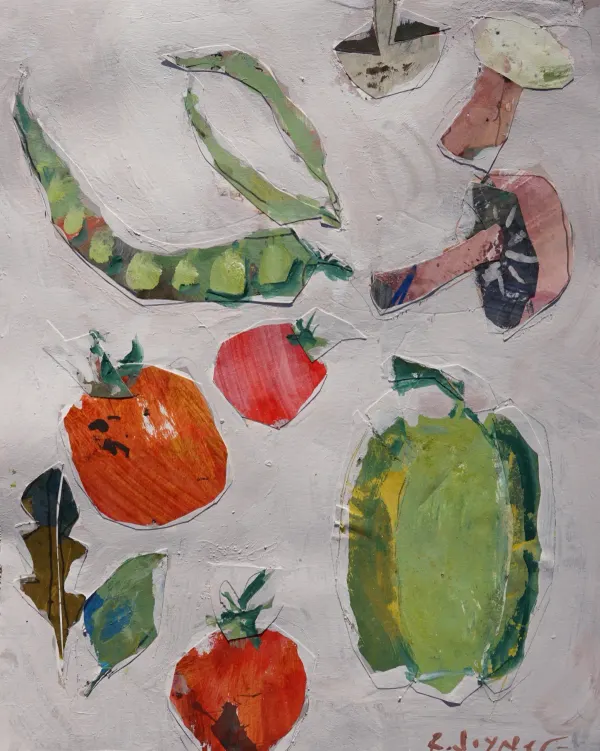
I use leftover drawing paper, some of it already has paint and scribbles on it. Then I take the leftover paint from the end of a session, whatever is still on my brush or palette, and smear it all over that paper.
Nothing gets wasted, and I end up with really cool collage paper that no one else has. If you want more ideas for using up scraps, see my easy mixed media fish painting.
Glue it down and keep it tidy
- Piece the shape together from your collage paper.
- Glue everything down really well. (Add the glue you use here.)
- Trim any excess hanging over the edges. It keeps things tidy as you go.
- Flip it over and give it a good press so everything lies flat.
- Hit it with a hair dryer. (I didn’t show that in the video, but I do it.)

Layer, tear, and experiment. Short, exclusive lessons and full courses on mixed media and collage.
Paint over it, but let the color show through
It might seem silly to paint over collage paper you just made, but it isn’t. I let some of the underlying color show through. Collage is a lot about texture, and in the close-up of the finished piece you can see the texture underneath the white area.
Gesture drawing for a loose still life
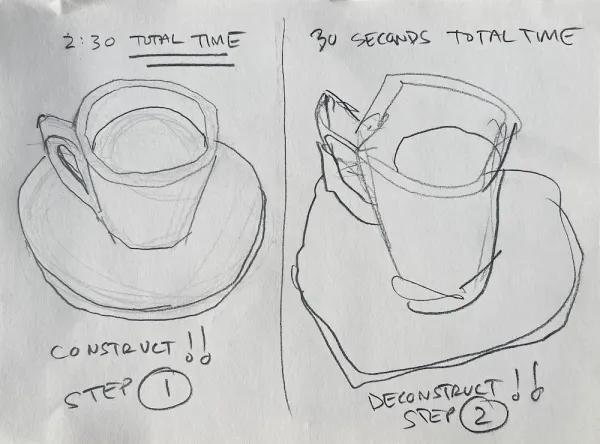
Gesture drawing is an important part of painting loose. Solid fundamentals are great, but a loose gestural drawing in your toolbox goes a long way. If your hand is stiff and you’re caught up in details, it’s hard to paint expressively. I encourage students to have both: the fundamentals underneath, and the ability to draw loose.
Here I scribe with pencil right back into the collage paper I glued over the white area. Check out my mixed media lemon still life for another take on drawing into collage.
Let the layers build the background
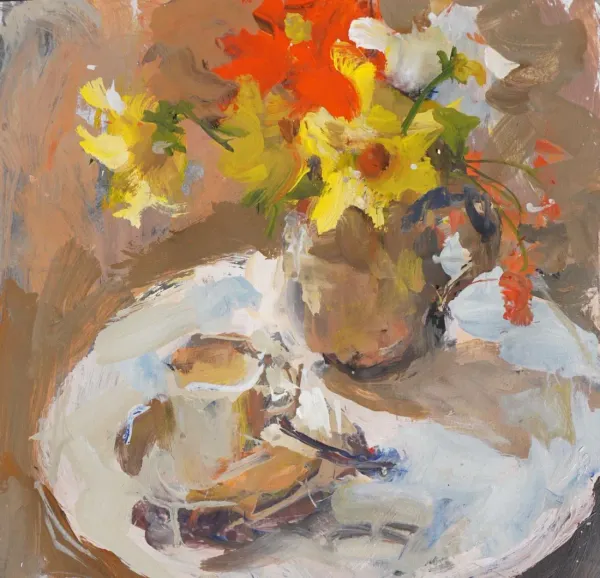
As the piece unfolds, the tabletop and background come together. The brown background isn’t flat or boring, and that’s all thanks to the handmade collage paper. If you look closely, you can see drawings and scribbles underneath the paint. That layering is what gives expressive artwork its depth.
A few details, then stop
Say it with me: a few details. You don’t need to describe every nuance. A good design and composition gives you your main shapes, and good color harmony pulls it together. I lean on earthy greens and browns here.
Then I suggest a few details so the viewer has something to latch onto. Just don’t go too bold or blocky, or there isn’t enough interest.
Make your own
Save your leftover paint at the end of your next session. Smear it on some scrap paper, let it dry, cut it up, and glue down a simple still life. Keep the shapes loose and the details few.
If you want the full uncut demo of this still life, it’s part of my mixed media still life course, and the mixed media bundle covers even more. You’ll find my courses on my Learn page.
Learn Structure. Paint Loose.
Construct. Deconstruct. Explore. Repeat.
Handmade collage paper FAQ
How do you make your own collage paper?
Smear leftover paint onto drawing paper or scrap paper. Use paint left on your brush or palette at the end of a session, and let it dry before cutting.
What paper is best for collage?
I like Bristol paper as the base because it’s smooth and collage pieces lie very flat. Canvas and watercolor paper have more tooth, which can make flattening harder.
Can you paint over collage paper?
Yes. Let some of the underlying color show through to keep texture and depth.
How do you keep collage paper from wrinkling?
Trim the overhang, flip it over, and press it flat after gluing. A hair dryer helps it set.