Negative Space Watercolor Painting: Easy Landscape Tutorial
Learn negative space watercolor painting with this loose coastal landscape tutorial. Simplify buildings, preserve white paper, and create expressive washes.

Want to paint looser watercolor landscapes? Stop trying to paint every building, boat, and tiny detail.
Try negative space watercolor painting instead: paint the spaces around your subjects and let the white paper do the rest.
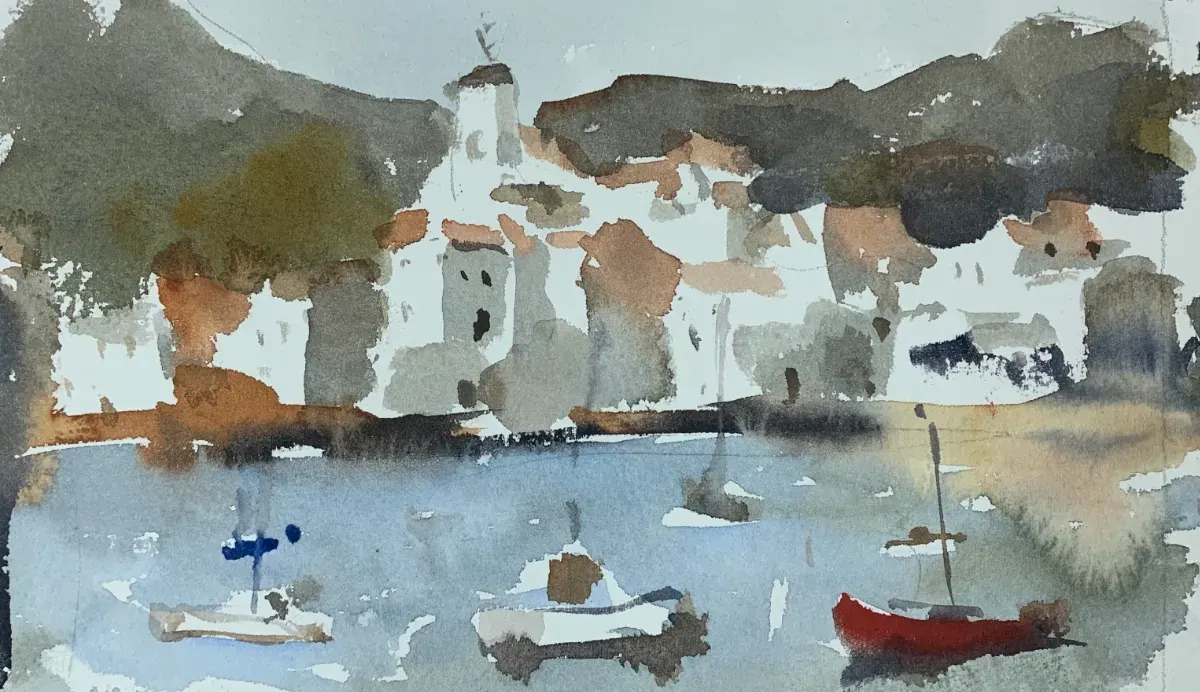
In this watercolor landscape demonstration, I show how negative space painting can simplify a coastal village scene while keeping the result expressive and believable.
What you need
- 140 lb Watercolor paper
- A pencil for a loose drawing
- A few brushes (a larger one for washes, a smaller one for accents)
- Watercolor in warm and cool grays, a blue, and a few darker accents
- Clean water and a palette
Paint around the subject, not just the subject
I start with a loose drawing, focusing on the major edges instead of individual details.
Then, using pale neutral washes, I paint the distant hills around the white buildings. This is negative space painting: the surrounding shapes define the subject without outlining everything.
The untouched white paper becomes an important part of the painting. It suggests buildings, boats, and highlights.
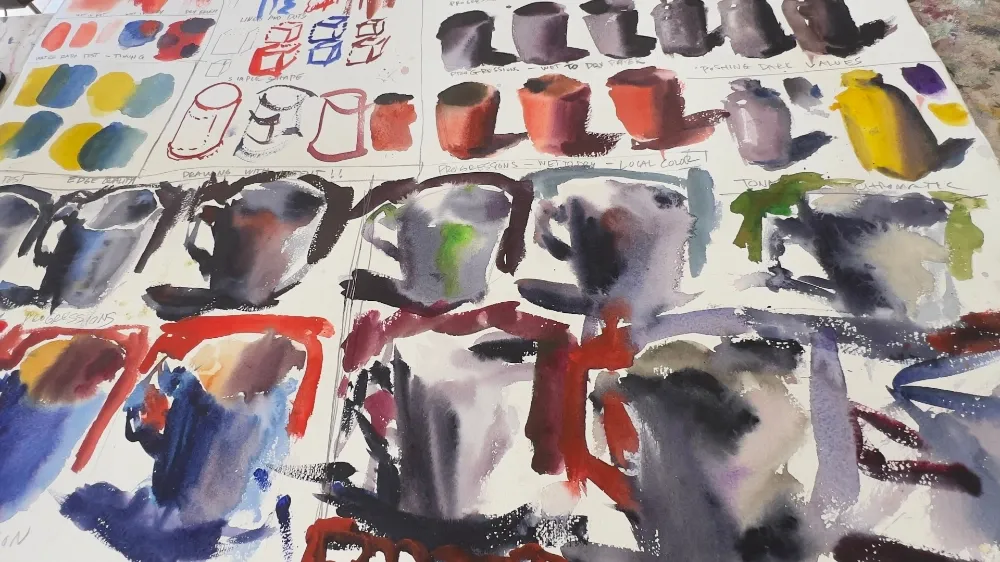
Want to Paint Loose Watercolors, Slacker? Learn the fundamentals, ditch perfection, and develop your own expressive style.
Simplify shapes and let colors mingle
Rather than painting every building separately, I treat the village as one large connected shape.
Subtle shifts in warm and cool grays suggest walls, shadows, and rooftops. A few darker accents add structure without making the painting feel tight.
I also let small flecks of white paper remain in the hills and water. They add texture and keep the washes fresh.
Use shape variety to create interest
Good composition isn’t just about where things go. It’s also about balancing large, medium, and small shapes.
- Large: the hills, village, and water
- Medium: the main building groups
- Small: windows, rooftops, and boat details that add contrast
A few vertical marks also break up the horizontal movement of the landscape.
The takeaway
You don’t need to paint everything. Learn to recognize the important shapes, use negative space to define your subjects, and let the viewer fill in the rest.
Want to plan a street scene instead? See my loose watercolor street scene tutorial. To loosen up the drawing underneath, try construct and deconstruct.
Learn Structure. Paint Loose.
Construct. Deconstruct. Explore. Repeat.
Negative space watercolor FAQ
What is negative space painting in watercolor?
Painting the area around a shape so the shape appears on its own, instead of outlining it. The untouched paper or a lighter wash becomes the subject.
How do you save whites in watercolor?
Paint around the areas you want to keep white and leave that paper untouched. (If you use masking fluid or lift paint, mention it here.)
What subjects work well for negative space painting?
Buildings, boats, trees, and flowers. Anything with a clear shape against a different background.
Does negative space painting make a landscape looser?
Yes. You skip outlining and let a few big shapes carry the scene, which keeps the painting simple and expressive.