Acrylic Painting for Beginners
Build a complete acrylic painting foundation from materials and brushwork through color, value, form, and light.
This 58-lesson course takes you step by step through the essential skills every acrylic painter needs. Start with the basics of materials, workspace setup, brush handling, and paint application, then move into color mixing, value, geometric forms, and light on form.
With 4+ hours of focused instruction and suggested assignments throughout, this course is designed to help complete beginners build real painting skills without getting overwhelmed.
-
Getting Started
-
Building Your Acrylic Foundation
-
Application Basics
-
Color Theory
-
Palette Management & Hues
Staying organized
-
Color Mixing Basics
Building blocks
-
How to Tint Hues
Controlling values 101
-
How to Tint Using Hue Family
Another option
-
How To Shade Hues
Controlling darker values
-
How To Shade Using Hue Family
Another way
-
Chroma, Saturation & Intensity
All the same
-
Reduce Chroma
Using Complimentary
-
Color Harmony Basics
Tried and True
-
-
Add Value To Your Art
-
Seeing Value
Keep it simple
-
How To Mix Gray
Good to know
-
Five Value Scale
Making a scale
-
Shade With Gray
Useful tips
-
Power Of Value
Master this
-
Shapes To Forms
Making three-dimensional forms
-
Cool Gray Demo
Temp in action
-
Warm Gray Demo
Controlling temp
-
Low Key Demo
Value and color control
-
High Key Demo
Controlling values
-
-
Color Mixing Drills & Exercises
-
Light On Form
-
Introduction
What you need to know
-
Light On Form Study
Start with a drawing
-
Light On Form Demo
Two color
-
Complex Value Demo
Value study
-
Make A Light-box
Optional
-
Local Color Introduction
Simplify colors
-
Colorful Blocks
Part 1
-
Colorful Blocks
Part Two
-
Colorful Blocks
Part 3
-
Colorful Blocks
Part 4
-
Apple & Blocks
Part 1
-
Apple & Blocks
Part 2
-
Workflow
Have a system
-
Bonus Project
Simple landscape
-
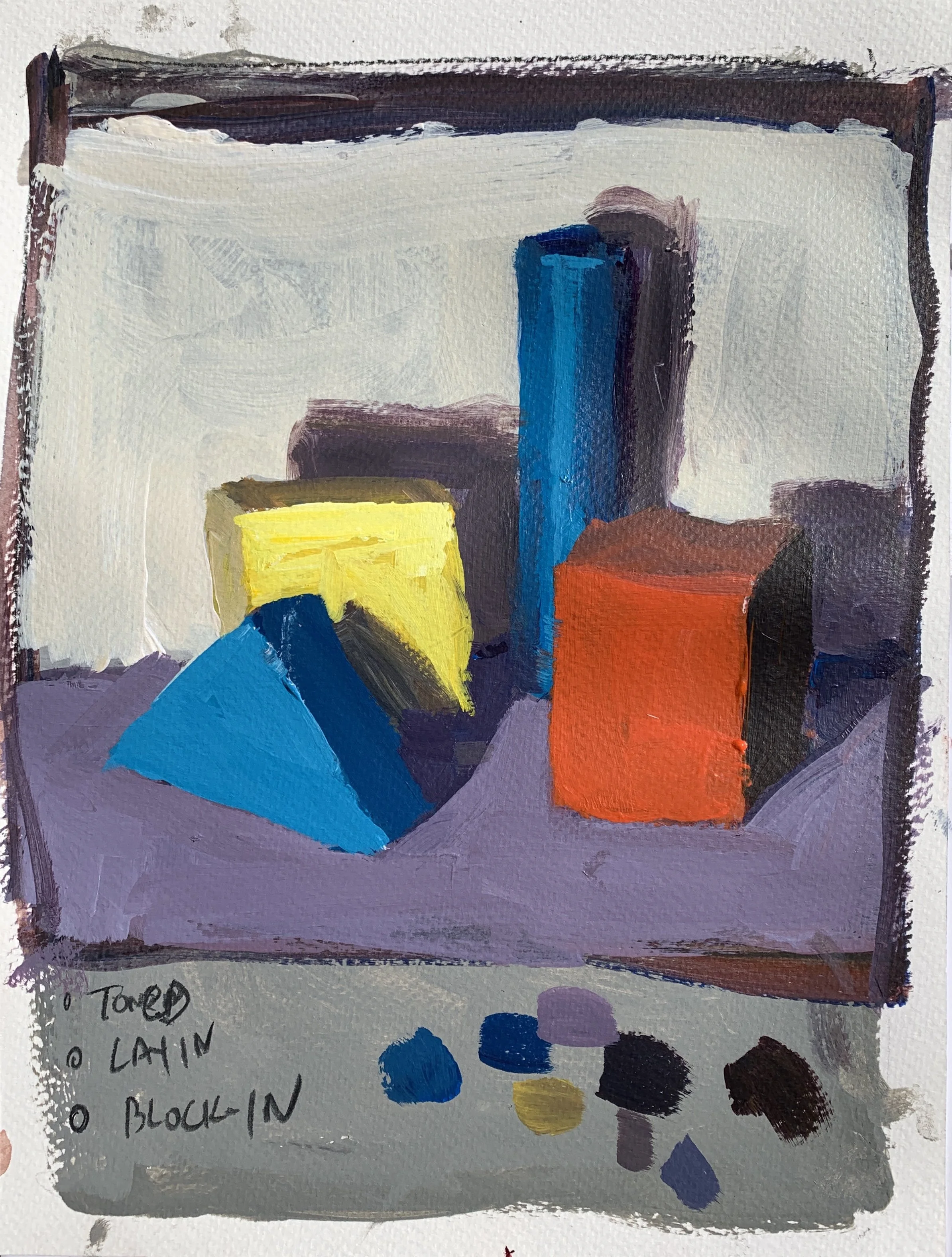
What You’ll Learn
Acrylic materials, drying time, and workspace setup
Brush anatomy and how different grips change your results
Brushwork mechanics and paint application
Blended, semi-blended, and direct painting techniques
Color mixing fundamentals
Tints, shades, chroma, saturation, and intensity
Color harmony and useful color relationships
How to see and mix values
Grayscale mixing and value scales
Value hierarchy and why it matters
Painting simple geometric forms
High-chroma and low-chroma color studies
Cylinders, spheres, cubes, pyramids, and other basic forms
Light on form and how it affects both color and value
Suggested assignments throughout the course