Watercolor Focal Point: Push One Thing, Let the Rest Fall Apart
Learn how to choose a focal point in watercolor. Find the one thing that excites you, push it, and combine wet-on-wet with dry brush so the rest can breathe.


Watercolor reminds me of my first adult league basketball game. I walked in confident, saw a bunch of older guys with gray hair, and thought I was about to cook them. A minute later I was looking for a fake injury so I could leave the game.
That’s watercolor. Sometimes it humbles you fast.
Why structure still matters
Loose painting doesn’t mean random painting. Underneath the chaos is the stuff holding the painting together: design, values, composition, edges, and movement. For the bigger picture, see loose watercolor isn’t random.
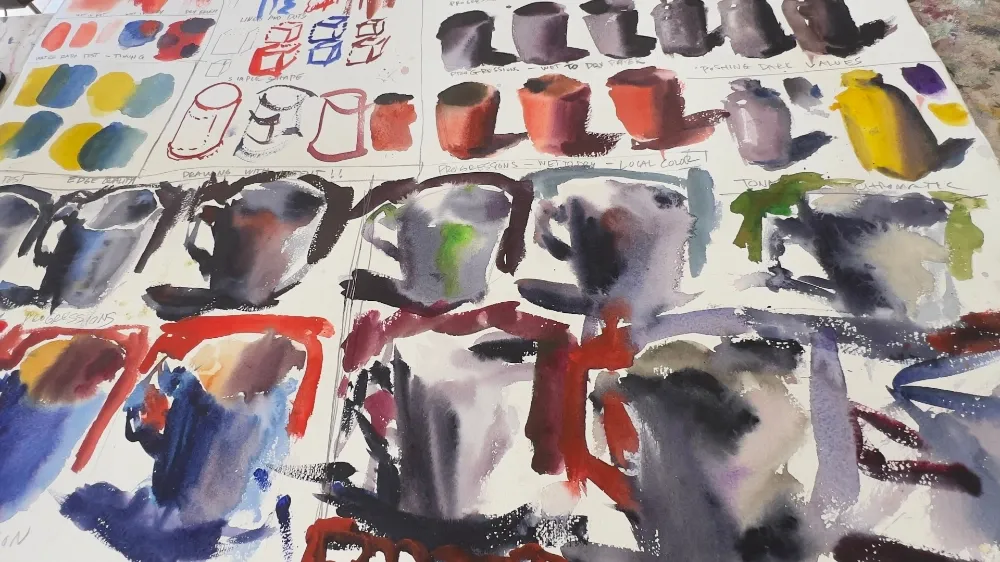
Want to Paint Loose Watercolors, Slacker? Learn the fundamentals, ditch perfection, and develop your own expressive style.
Use wet-on-wet and dry brush together
Watercolor can get away from you quickly.
- Wet-on-wet gives you soft edges and happy accidents.
- Dry brush gives you structure and control.
A good painting usually has both.
Find the “why” and choose your focal point
The biggest mistake I see is trying to control every inch of the painting. That usually kills the energy.
What matters is understanding why you’re painting this. What excites you? Maybe it’s:
- The figures
- The car
- The light and shadow
- The shape of a building
That’s the thing you push. The rest can fall apart.
Not every area needs equal attention
It’s usually better if it doesn’t. The contrast between control and collapse is where the emotion starts to happen.
Practice structure, not just objects
When you practice, don’t just paint objects. Practice structure, design, and value, and practice figuring out what matters. Once those become second nature, you can loosen up and let the medium breathe.
For a planning method, see my loose watercolor street scene tutorial. For tight versus loose, see why your watercolors look stiff.
Try it yourself
- Pick a scene.
- Ask what excites you most about it.
- Paint that area with the most care (darks, edges, contrast).
- Let the other areas stay soft and unfinished.
Learn Structure. Paint Loose.
Construct. Deconstruct. Explore. Repeat.
Watercolor focal point FAQ
How do I choose a focal point in watercolor?
Ask what excites you most about the scene, such as a figure, a car, light and shadow, or a building shape. Push that.
Should every area get equal detail?
No. Give the focal point the most attention and let other areas stay soft or unfinished.
What’s the difference between wet-on-wet and dry brush?
Wet-on-wet gives soft edges and blending. Dry brush gives crisp texture and control.
How do I stop controlling every inch of my painting?
Decide your focal point first. Then you know which areas can be left loose.