Watercolor Color Mixing for Beginners: The 6-Color Split-Primary Palette
Learn watercolor color mixing for beginners with just six paints. Mix secondary and tertiary colors using a split-primary palette, plus why mixes turn muddy.

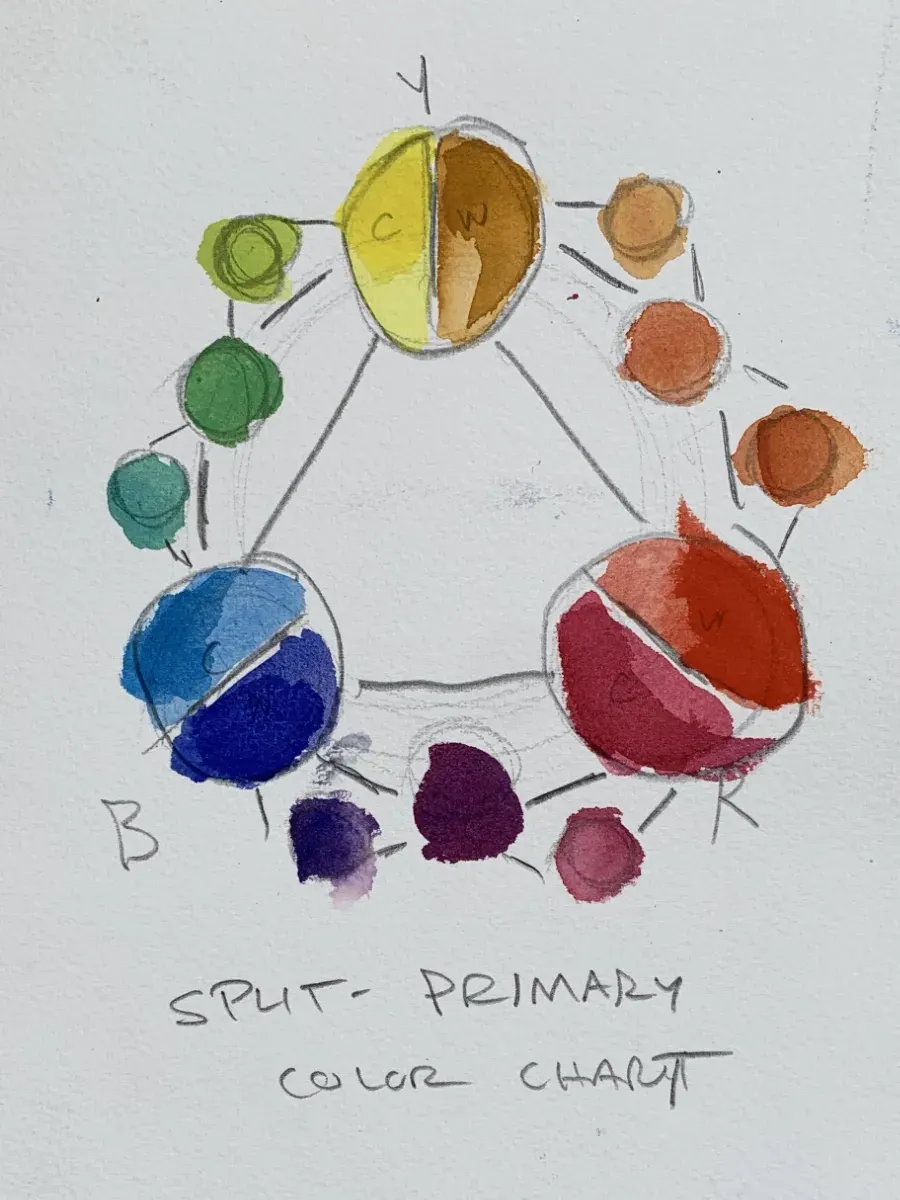
Think you need 30 or 40 paints to mix beautiful watercolor colors?
You don’t. In this free beginner watercolor color mixing tutorial, I show you how to mix a huge range of colors using just six paints.
It’s called the split-primary system, and it can save you a lot of frustration, muddy mixtures, and unnecessary trips to the art supply store.
Why use six primary colors instead of three?
Most of us learned three primaries in grade school: red, yellow, and blue. That’s a useful start, but not all reds, yellows, and blues behave the same way. Some lean warm and some lean cool, and that changes the colors you get when you mix them.
So I use two versions of each primary, one warm and one cool. That gives you a six-color palette with a lot of mixing power.
My six-color watercolor palette
- Yellow: Cadmium Yellow Lemon (cool), Yellow Ochre (warm)
- Red: Alizarin Crimson (cool), Cadmium Red Light (warm)
- Blue: Cerulean Blue (cool), Ultramarine Blue (warm)
You don’t need these exact paints. Any warm and cool version of each primary will work, and results vary a bit by brand. Clean your palette and brush before you start so leftover pigment doesn’t sneak into your mixes.
Mixing secondary watercolor colors
With the six primaries on your chart, mix the secondaries:
- Orange: Yellow Ochre + Cadmium Red Light
- Violet: Alizarin Crimson + Ultramarine Blue
- Green: Cerulean Blue + Cadmium Yellow Lemon
Start with roughly equal amounts, then adjust. The goal is to see how your pigments behave, not memorize a formula.

Short, exclusive lessons and full courses on loose, expressive watercolor. Start with a $5/month membership or jump into a course.
Creating tertiary colors
Now take those secondaries further by shifting the ratio.
- More yellow in your orange gives yellow-orange. More red gives red-orange.
- A little more ultramarine pushes violet toward blue-violet. More Alizarin Crimson moves it toward red-violet.
- Green can swing anywhere from turquoise to yellow-green.
Six paints suddenly give you a much bigger range.
Why some watercolor mixtures turn muddy
I deliberately mix some combinations that come out more muted:
- Ultramarine Blue + Yellow Ochre makes an earthy green-gray, not a bright green.
- Cadmium Red Light + Ultramarine Blue makes a subdued violet, not a vibrant one.
Muted colors aren’t bad colors. They’re great for landscapes, shadows, architecture, and expressive painting. What matters is mixing them on purpose.
Want a bright violet? Pick pigments that lean toward each other. Want a quiet neutral? Choose a different pair. That’s color control.
Make your own split-primary color wheel
The best way to learn this is to make a chart with the paints you already own. Start with your warm and cool primaries, mix the secondaries, and play with ratios for the tertiaries. Then try other combinations and notice which stay vibrant and which turn neutral.
You’ll learn more from that than from buying another dozen tubes of paint.
Learning to mix color gives you more freedom to paint loose.
Learn Structure. Paint Loose.
Construct. Deconstruct. Explore. Repeat.
Watercolor color mixing FAQ
What are the best 6 watercolor colors for beginners?
A warm and cool version of each primary: Cadmium Yellow Lemon and Yellow Ochre, Alizarin Crimson and Cadmium Red Light, Cerulean Blue and Ultramarine Blue.
What is a split-primary palette?
A palette with two versions of each primary color, one warm and one cool. It gives you cleaner, more varied mixes than a basic three-color set.
Why do my watercolor mixes turn muddy?
Usually it’s mixing colors that lean toward their opposites, or combining too many pigments at once. Fewer pigments per mix keeps colors cleaner.
Do I need to buy these exact paints?
No. Any warm and cool version of each primary will work. Test your own paints and see what they do.